
Many people assume product design is simply about creating attractive interfaces. In reality, product design is a strategic process that combines research, problem-solving, user experience, business thinking, and visual design.
What Is Product Design?
Product design is the process of identifying user problems and creating solutions that are useful, usable, and desirable.
It combines several disciplines, including:
User Experience (UX) Design
User Interface (UI) Design
User Research
Interaction Design
Product Strategy
Prototyping
Usability Testing
The ultimate goal is to create products that solve real problems while supporting business growth.
Step 1: Discovery and Research
Every successful product begins with understanding the problem.
Before creating wireframes or interfaces, teams must gather insights about users, competitors, and market opportunities.
Common research activities include:
User interviews
Stakeholder workshops
Competitor analysis
Market research
Customer surveys
Analytics reviews
This phase helps answer important questions:
Who are the users?
What challenges do they face?
What solutions already exist?
What opportunities are available?
Strong research reduces assumptions and increases confidence in future design decisions.
Step 2: Defining the Problem
Once research is complete, the next step is defining the core problem.
Many projects fail because teams focus on symptoms rather than root causes.
A clearly defined problem statement helps align teams and ensures everyone is working toward the same objective.
For example:
Instead of saying:
"Users are not using our dashboard."
A stronger problem statement might be:
"Users struggle to find meaningful insights quickly, causing low engagement and retention."
The clearer the problem, the better the solution.
Step 3: User Flows and Information Architecture
Before designing screens, product teams map how users will interact with the product.
This includes:
User journeys
Navigation structures
Content organization
Task flows
Information architecture helps create logical experiences that feel intuitive and easy to navigate.
At this stage, teams focus on structure rather than visuals.
Step 4: Wireframing
Wireframes are simplified layouts that show content placement and functionality without visual styling.
Their purpose is to:
Validate ideas quickly
Explore multiple solutions
Reduce design risks
Align stakeholders
Wireframes allow teams to focus on usability before investing time in high-fidelity design.
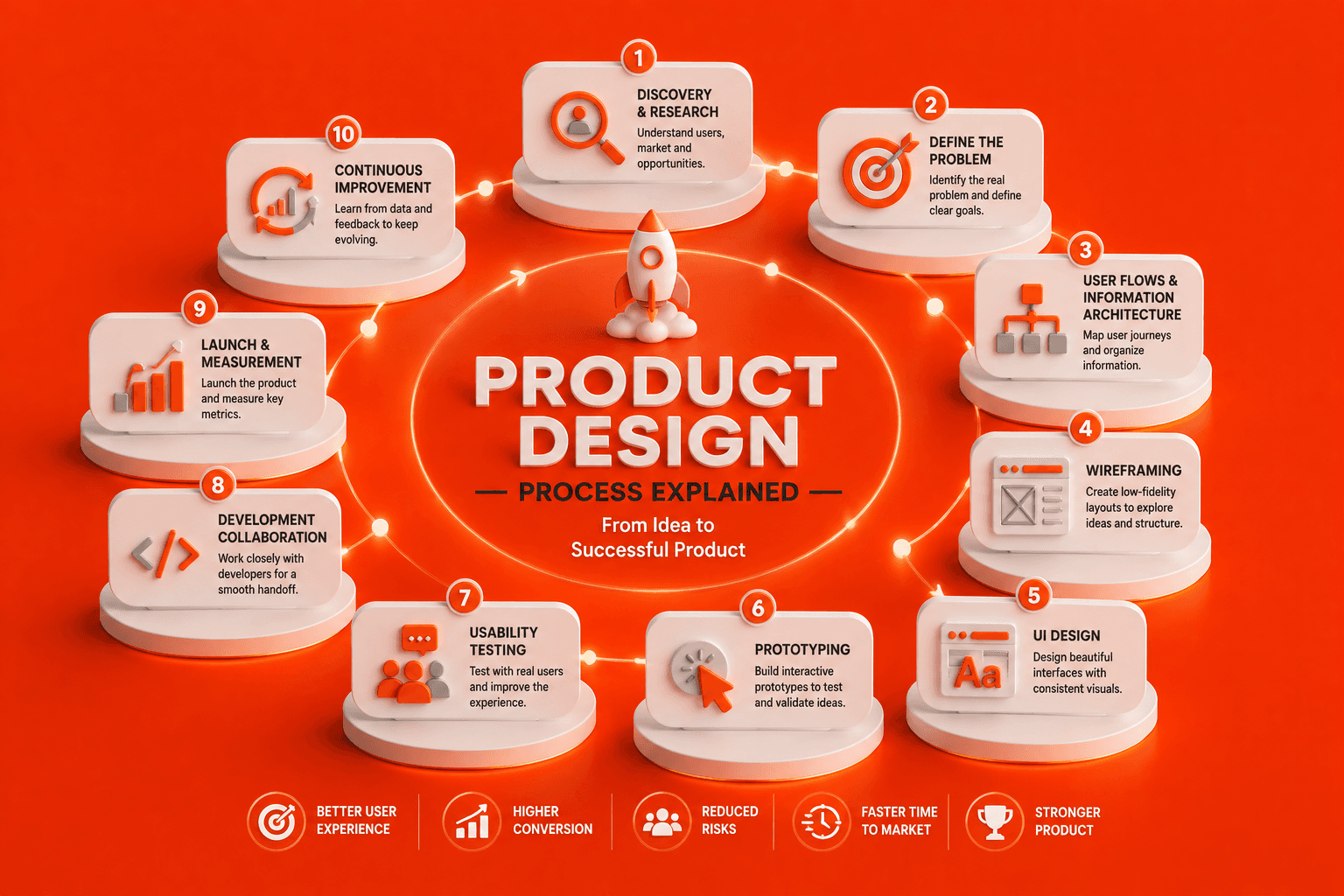
Step 5: UI Design
Once wireframes are validated, designers begin creating the visual interface.
UI design focuses on:
Typography
Colors
Layout systems
Design consistency
Visual hierarchy
Accessibility
The objective is not only to create beautiful interfaces but also to support usability and improve the overall user experience.
Good UI helps users understand information faster and complete tasks more efficiently.
Step 6: Prototyping
Prototypes simulate real interactions before development begins.
Interactive prototypes help teams:
Test workflows
Demonstrate functionality
Gather stakeholder feedback
Identify usability issues
Prototyping saves significant development costs by uncovering problems early in the process.
Step 7: Usability Testing
Great product teams validate ideas before launch.
Usability testing involves observing real users as they interact with the product.
Testing helps identify:
Navigation issues
User confusion
Friction points
Missing functionality
Inefficient workflows
Even small usability improvements can dramatically improve product performance.
Step 8: Development Collaboration
Design and development should work together closely.
A smooth handoff includes:
Design systems
Component libraries
Interactive prototypes
Clear documentation
Strong collaboration ensures the final product matches the intended user experience.
Step 9: Launch and Measurement
Launching a product is not the end of the process.
After release, teams monitor performance using metrics such as:
User engagement
Conversion rates
Retention rates
Feature adoption
Customer satisfaction
Real-world data provides valuable insights for future improvements.
Step 10: Continuous Improvement
The best digital products evolve continuously.
User needs change.
Markets change.
Technology changes.
Successful companies regularly refine their products through:
User feedback
Analytics
A/B testing
Feature improvements
UX enhancements
Product design is an ongoing cycle rather than a one-time project.
Why a Structured Product Design Process Matters
A well-defined process helps businesses:
Reduce development costs
Improve user satisfaction
Increase conversion rates
Minimize project risks
Accelerate product-market fit
Build stronger products
Without a structured process, teams often waste time building features users don't need.
Conclusion
Product design is far more than creating attractive screens. It is a strategic process that combines research, problem-solving, design thinking, testing, and continuous improvement.
The most successful products are built through a deep understanding of users and a commitment to solving meaningful problems.
By following a structured product design process, businesses can create products that not only look great but also deliver measurable value for users and long-term growth for the company.
[OUR BLOG]


